
Accounting Automation Case Study:
How Traditional Finance Operations Were Transformed into a Scalable, Error-Reduced, Compliance-Ready System
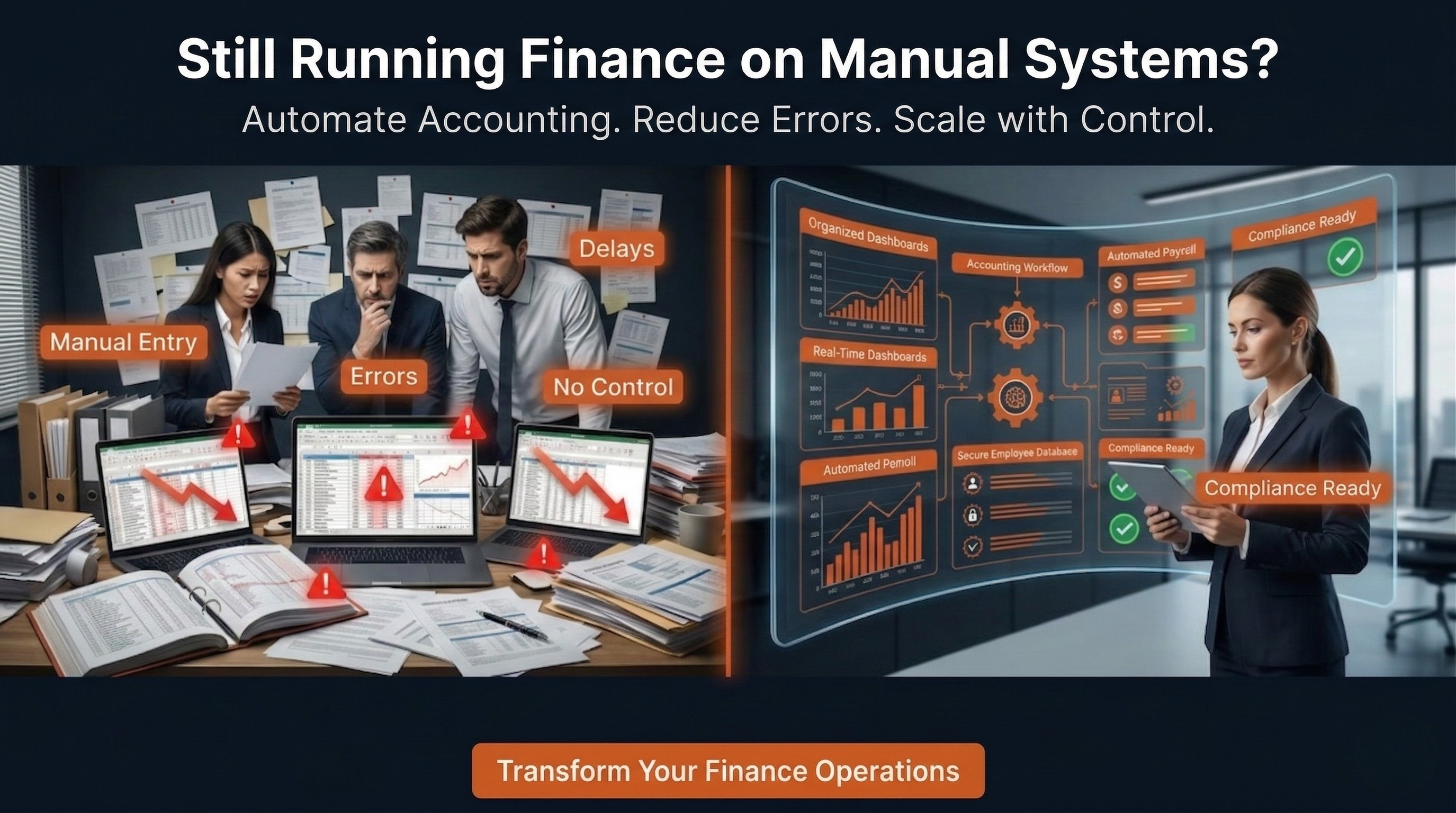
Accounting Automation Case Study: How Traditional Finance Operations Were Transformed into a Scalable, Error-Reduced, Compliance-Ready System
Case Study | Strict NDA Compliance | Financial Process Optimization
When accounting runs on manual effort, businesses pay twice: once in cost, and again in risk.
Executive Summary
In this Independent Case Study Under Strict NDA Compliance documents how Acumen Financial Solutions transformed a traditional accounting environment into a streamlined, automation-driven financial operating model.
The engagement involved a business operating with legacy processes, fragmented records, manual bookkeeping, payroll delays, inconsistent employee data, and weak internal controls. These inefficiencies created avoidable errors, compliance exposure, and poor visibility for management.
Acumen Financial Solutions designed and implemented a structured finance transformation framework centered on:
Automated bookkeeping
Data migration from legacy systems to modern accounting software
Salary processing automation
Employee database management
Internal controls evaluation and strengthening
The result was a faster, cleaner, more scalable finance process with materially improved accuracy, lower operational friction, and better management reporting. Under strict NDA, client identity remains undisclosed, but the operating model, execution framework, and business outcomes are real-world and replicable.
Client Background
The client operated in a fast-moving business environment where finance operations had grown organically rather than strategically. Over time, the accounting function became dependent on manual entries, repeated corrections, spreadsheet-heavy workflows, and disconnected recordkeeping.
As transaction volume increased, the existing system struggled to keep pace. Payroll, employee records, bookkeeping, and control checks were handled through separate processes, creating bottlenecks and increasing the chance of error.
The business did not lack intent or effort. It lacked a modern finance system.
That distinction mattered.
Problem Statement
The core issue was not simply “messy books.”
The deeper issue was that the financial process itself had not evolved with the business.
The client faced:
Manual bookkeeping with high dependency on human intervention
Inconsistent classification of transactions
Delay in monthly closing activities
Payroll inaccuracies and reconciliation issues
Disconnected employee master data
Weak audit trails and limited process visibility
Internal control gaps across approval, review, and exception handling
Scaling limitations as transaction volume increased
In short, the finance function was operationally busy but strategically underperforming.
Challenges Faced
1. Operational Inefficiency
Multiple finance tasks were being performed manually, often by different people using different methods. This reduced standardization and made the process vulnerable to inconsistency.
2. Compliance Risk
When data is not organized properly, compliance becomes reactive rather than proactive. Delays, misstatements, and mismatches can quickly become regulatory and reputational risks.
3. Payroll Complexity
Salary processing required repeated checks, but the absence of an integrated system created room for timing errors, mismatches, and communication delays.
4. Data Fragmentation
Employee data, accounting records, and payroll inputs were not aligned in a unified structure. This created duplication, confusion, and reconciliation delays.
5. Weak Internal Controls
A finance function cannot scale safely without control discipline. In this case, approvals, exception checks, and review logic were not sufficiently robust.
6. Limited Management Visibility
Leadership lacked a clean, decision-ready financial picture. That made planning slower and less reliable.
Solution Delivered
Acumen Financial Solutions executed a transformation program built around automation, control, and process redesign.
The goal was not simply to “fix records.”
The goal was to create a finance system that could operate accurately, consistently, and at scale.
The solution covered five core areas:
Automated bookkeeping implementation
Application data migration
Salary processing automation
Employee database management
Internal controls evaluation and strengthening
Each area was handled as part of a single connected finance architecture.
Automation Strategy
The automation strategy focused on reducing manual touchpoints without compromising control.
Bookkeeping Automation
Routine accounting tasks were mapped into repeatable workflows. This reduced dependency on ad hoc entry and improved consistency across transaction categories.
Key elements included:
Standardized transaction classification
Recurring entry handling
Rule-based posting logic
Exception review workflow
Faster month-end close support
Data Migration in Accounting
The client’s legacy records were migrated into a modern accounting environment with an emphasis on accuracy, structure, and continuity.
Migration principles included:
Clean extraction of historical data
Reconciliation before import
Mapping old categories to a new chart of accounts
Validation after migration
Retention of audit trail integrity
Payroll Automation
Salary processing was converted from a manual, error-prone activity into a controlled workflow.
This improved:
Salary calculation accuracy
Timely processing
Deduction and adjustment handling
Compliance consistency
Reduction in payroll disputes
Employee Database Management
Employee information was consolidated into a structured database to ensure one source of truth.
Benefits included:
Better employee record accuracy
Simplified payroll inputs
Easier updates and retrieval
Reduced duplication and mismatch risk
Internal Controls Improvement
Controls were redesigned to make the process more reliable and reviewable.
This included:
Role-based responsibility alignment
Approval and review checkpoints
Exception tracking
Reconciliation discipline
Segregation of duties where possible
Implementation Process
Phase 1: Diagnostic Review
The finance process was first assessed end-to-end. This helped identify where errors originated, where delays occurred, and where control weaknesses were concentrated.
Phase 2: Process Mapping
Current workflows were documented and compared against the desired future state. This revealed redundant steps, manual dependencies, and weak approval paths.
Phase 3: Data Cleanup and Migration Planning
Before migration, records were reviewed for consistency. Historical data was mapped carefully to avoid introducing new errors into the modern system.
Phase 4: Automation Deployment
Structured workflows were introduced to support bookkeeping, payroll, and master data handling. The objective was not full automation for its own sake, but meaningful automation that reduced effort and improved quality.
Phase 5: Control Framework Strengthening
Internal controls were redesigned around review, approval, reconciliation, and exception management.
Phase 6: Stabilization and Monitoring
After implementation, the system was monitored for stability, accuracy, and process adoption. This ensured the transformation was sustainable, not temporary.
Key Improvements / Results
The transformation produced measurable improvements across finance operations.
Illustrative outcomes included:
30% to 50% reduction in manual bookkeeping effort
Faster monthly closing cycle
Lower error rate in transaction processing
Improved payroll accuracy and timeliness
Cleaner employee records with fewer mismatches
Stronger audit trail and process transparency
Better visibility for management reporting
Reduced dependency on individual memory or manual follow-up
In practical terms, the finance function became more predictable, more scalable, and more trustworthy.
Internal Controls & Risk Reduction Impact
One of the most valuable outcomes of this engagement was not just speed — it was control.
A finance function with weak controls may appear productive, but it remains vulnerable to:
unnoticed errors
duplicate entries
missed approvals
payroll inconsistencies
poor accountability
compliance failures
By strengthening internal controls, Acumen Financial Solutions helped reduce these risks materially.
Control improvements included:
Documented workflows
Structured review gates
Better reconciliation discipline
Segregation of duties principles
Exception handling logic
Better traceability of activity
This is the kind of improvement that protects a business long after the initial project ends.
Business Impact
The business impact extended beyond accounting.
1. Better Decision-Making
When books are clean, leadership can make faster and more informed decisions.
2. Cost Optimization
Automation reduced wasted manual effort and lowered the hidden cost of rework.
3. Scalability
The finance function was no longer trapped by manual volume limits.
4. Compliance Confidence
A more reliable system reduced the risk of avoidable mistakes.
5. Operational Stability
Payroll, bookkeeping, and employee records started working as a connected system rather than separate silos.
Key Learnings & Insights
This project reinforced several important principles:
Accounting automation works best when it is process-led, not tool-led.
Software alone does not solve finance inefficiency. The workflow must be redesigned first.
Data migration must be controlled, not rushed.
Poor migration creates long-term problems. Clean mapping and validation are essential.
Payroll automation should be integrated with employee data.
Disconnected systems create avoidable errors.
Internal controls are a growth enabler.
Controls are not bureaucracy. They are what make scale possible without losing accuracy.
Financial process optimization must serve decision-making.
The final output should not just be records. It should be clarity.
Conclusion
This Independent Case Study | Strict NDA Compliance demonstrates how Acumen Financial Solutions helps businesses move from manual accounting dependence to a more modern, automated, and control-oriented finance model.
By combining accounting automation, bookkeeping automation, payroll automation, data migration in accounting, and internal controls improvement, the engagement created a finance function that was cleaner, faster, and more scalable.
For businesses facing messy books, payroll delays, weak controls, or fragmented financial systems, the lesson is simple:
The right accounting transformation does not just reduce errors — it creates business confidence.
Acumen Financial Solutions stands for precision, confidentiality, speed, and measurable financial improvement.